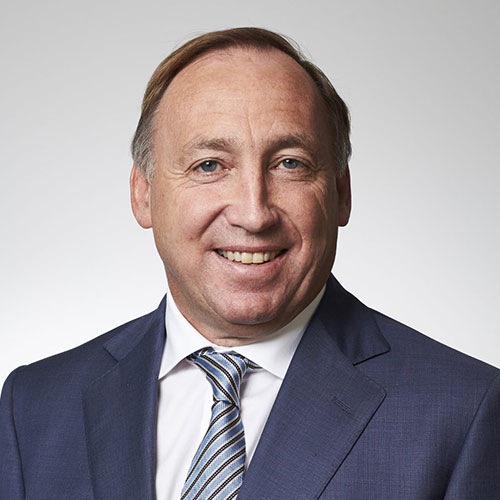
Mark Delaney
Deputy Chief Executive & Chief Investment Officer
Get their honest, personalized take on your startup.
Sign in to pitch Mark →At a glance
- Full Name
- Mark Delaney
- Title
- Deputy Chief Executive & Chief Investment Officer (stepping down 30 June 2026)
- Firm
- AustralianSuper
- Firm Type
- Institutional investor / industry superannuation (pension) fund — *not* an angel investor (the stub label "Angel Investors" is incorrect)
- Investment Stage
- Large-scale institutional / late-stage and mature private-market assets (infrastructure, private equity, property, private credit) and public markets — *not* seed-stage
- Check Size
- Very large — equity commitments frequently A$1–2.5 billion per deal (e.g., US$1.5bn into DataBank; €1.5bn into Vantage EMEA)
- Target Company Profile
- Mature, cash-generative platforms and assets at scale — data centres, ports, toll roads, airports, energy networks, and established private-equity portfolio companies
- Sector Focus
- Infrastructure, private equity, real estate/property, private credit, and listed equities/fixed income
- Geographic Focus
- Global — Australia (home market), the United States (major New York build-out), and the UK/Europe (£18bn UK target by 2030)
- Location
- Melbourne, Victoria, Australia
Background
Mark Delaney has been Deputy Chief Executive and Chief Investment Officer of AustralianSuper since 1 July 2006, the day the fund began operating following the merger of the Australian Retirement Fund (ARF) and the Superannuation Trust of Australia (STA). As CIO he is responsible for the strategic direction and performance of the fund's entire investment program and acts as an adviser to the board. In December 2025 the fund announced he will step down after 25 years, remaining in the role until 30 June 2026 while a global search for his successor is conducted.
Before AustralianSuper, Delaney was Chief Executive (and Head of Investments) of the Superannuation Trust of Australia for three years, having been promoted from investment manager, prior to the STA–ARF merger. Earlier he spent 14 years at National Mutual/AXA, first as an economist and later as Senior Manager of Investment Services. He began his career as an economist at Australia's Federal Department of Treasury, where he worked for about four years.
Delaney holds a Bachelor of Economics (Honours) and is a Chartered Financial Analyst (CFA) charterholder. Beyond AustralianSuper he sits on the IFM Investors Advisory Board and has served as a director/Vice Chair of the Pacific Pension & Investment Institute (PPI) since early 2021.
Over Delaney's tenure AustralianSuper grew from roughly A$20 billion in assets to more than A$400 billion, with around A$190 billion of that growth attributable to investment returns generated under his leadership — making him one of the most influential institutional investors in Australia and among the world's larger pension CIOs.
Investment Thesis & Focus
- Champions active management and internalisation — moving the majority of the fund's assets to in-house management to cut costs and capture scale ("more resilient, for less").
- Strong conviction that unlisted assets — infrastructure, private equity and property — are essential return drivers; the balanced option has run roughly 27–28% in unlisted assets (infrastructure ~12–13%, property ~10%, private equity ~4.5%).
- Actively scaling private equity, targeting a lift in the balanced option's PE allocation from ~5% toward as much as 8%, largely via US relationships built out of the New York office.
- Treats private credit as a deliberately small allocation, favouring infrastructure and real assets for durable, inflation-linked cash flows.
- In his own words: *"We transformed superannuation investing in Australia by becoming an active investor in a range of asset classes and building a globally diversified portfolio so every member can now invest in world-class opportunities at scale."*
- Willing to publicly own mistakes — he called the fund's pandemic-era unlisted (retail) property positioning *"the wrong strategy"* and moved to unwind it, signalling a pragmatic, evidence-led approach.
- A disclosure leader: introduced portfolio holdings disclosure ahead of regulatory requirements.
Notable Investments
- DataBank (2024) — First US data-centre investment; ~US$2.2bn deal with ~US$1.5bn in equity, becoming a significant minority owner and taking a board seat to fund campus expansion in Texas, Virginia and Georgia.
- Vantage Data Centers EMEA (2023) — €1.5bn investment (part of a ~US$2.5bn deal with DigitalBridge), taking a significant minority stake and joining as a key shareholder.
- King's Cross Estate, London — ~74% stake in the major London mixed-use regeneration estate; a flagship UK real-estate holding.
- Peel Ports Group (UK) — ~32% interest, acquired (alongside APG and Global Infrastructure Partners) via a 37.4% stake purchase from DWS.
- WestConnex (Sydney) — Stake in the WestConnex toll-road network (part of a ~A$11bn, 49% consortium transaction).
- Ausgrid (NSW) — Ongoing direct interest (~8.4%) in the NSW electricity distribution network.
- Australia Tower Network — Acquired a ~70% stake in the telecom towers business.
- Broader infrastructure book of A$24bn+ globally, including NSW Ports, Transurban Queensland and Perth Airport.
Unlock the full research
Get how to approach them, recent activity, sources, contact links — plus pitch their AI twin for a candid read on your raise.
One-time. Stays unlocked for you.